
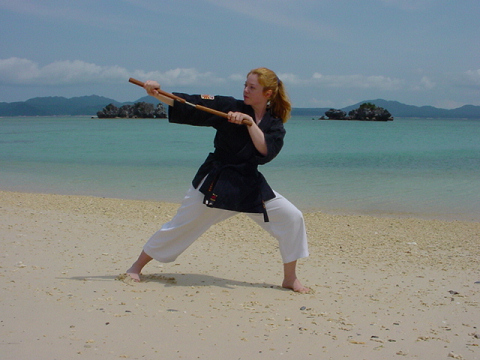
 Traditional Japanese Nunchakus, originating from Okinawa Island, are made of wood and are linked by a rope. It has never be seen a metal version of theses Nunchakus, neither of a version linked by a chain. They have specific features quite different as common Nunchakus:

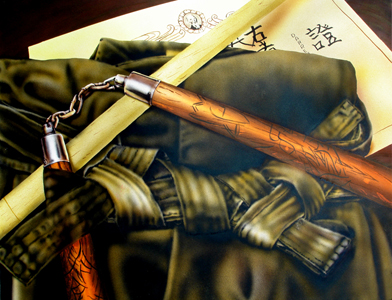 When a pupil reaches a good knowledge and a good skill level, after few years of handling, he is allowed to practice the ‘Renzoku-bunkaï’: another student attacks him with predefined attacks to make the pupil able to stop them or counter them by also predefined techniques. To simplify matters, let’s say that is kata forms for two people. This exercise is firstly performed with low velocity and speed, allowing an easier memorization of moves without injuries. Velocity and global speed are, then, gradually increased. Renzoku-bunkaï is useful for acquiring reflex, for example to link some block moves to specific attacks. It is really helpful in a true fight situation: the pupil will perform the right move face to his opponent attacks. Many weapons are used to attack the pupil handling Nunchaku but the most used is the staff.
Next step for a pupil is Kumite: it is in fact a true armed fight situation against another pupil. Years ago, only high level student could be allowed to practice Kumite because a simple mistake while attacking can quickly become fatal. Obviously, the two pupils performing had not to kill each other: the aim was to disarm his opponent or to beat him hollow. But, this way of practice is nevertheless dangerous. Nowadays, pupils are earlier allowed to practice Kumite, using protective clothes and safety Nunchakus to avoid injuries. Theses Japanese techniques are very effective in a real fight situation because they are learnt in a quite realist way throughout Kumite instruction.
When a pupil reaches a good knowledge and a good skill level, after few years of handling, he is allowed to practice the ‘Renzoku-bunkaï’: another student attacks him with predefined attacks to make the pupil able to stop them or counter them by also predefined techniques. To simplify matters, let’s say that is kata forms for two people. This exercise is firstly performed with low velocity and speed, allowing an easier memorization of moves without injuries. Velocity and global speed are, then, gradually increased. Renzoku-bunkaï is useful for acquiring reflex, for example to link some block moves to specific attacks. It is really helpful in a true fight situation: the pupil will perform the right move face to his opponent attacks. Many weapons are used to attack the pupil handling Nunchaku but the most used is the staff.
Next step for a pupil is Kumite: it is in fact a true armed fight situation against another pupil. Years ago, only high level student could be allowed to practice Kumite because a simple mistake while attacking can quickly become fatal. Obviously, the two pupils performing had not to kill each other: the aim was to disarm his opponent or to beat him hollow. But, this way of practice is nevertheless dangerous. Nowadays, pupils are earlier allowed to practice Kumite, using protective clothes and safety Nunchakus to avoid injuries. Theses Japanese techniques are very effective in a real fight situation because they are learnt in a quite realist way throughout Kumite instruction. 
